In September 2025 we made a test and review on the penetration capabilities of our PXR GEN160-09 battery driven generator when applied on 6” to 8” pipes using DWDI imaging method (link to text).
Results showed impressive penetration when GEN160-09 is used in combination with suitable DR detectors. However this test was limited to DWDI method using pipes with diameters in range of ~150 – 200 mm. This method enables very short exposure distances and is thus a relatively “easy” method in regards to penetration.
This time we wanted to focus on DWDI method, as this method requires longer distances (SDD) to meet the inspection class B according to ISO 17636-2.
The GEN160-09 sports a focal spot of 0.9 mm, which enables really short distances even in case of DWDI method. In this test we used distance of SDD = 400 mm.
Test setup:
- GEN160-09 battery generator, max 160kV, 1 mA
- PXR Micro 10 panel, 100µm, D10
- Welding sample pipes, variable thicknesses, see table below
- X-ray cabinet
- IQI requirements are defined as per ISO 17636-2, class B, DWDI
Referred test methods:
- DWSI = double wall, single image method. Method 7.1.8 in ISO 17636-2.
- DWDI = double wall, double image. Method 7.1.6 and 7.1.7 in ISO 17636-2.
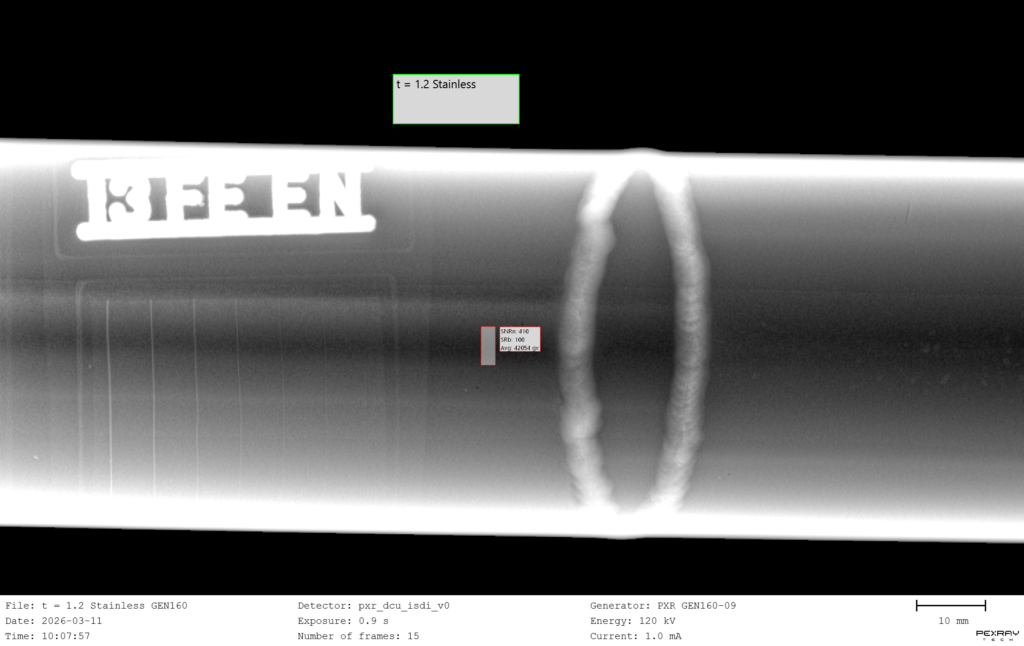
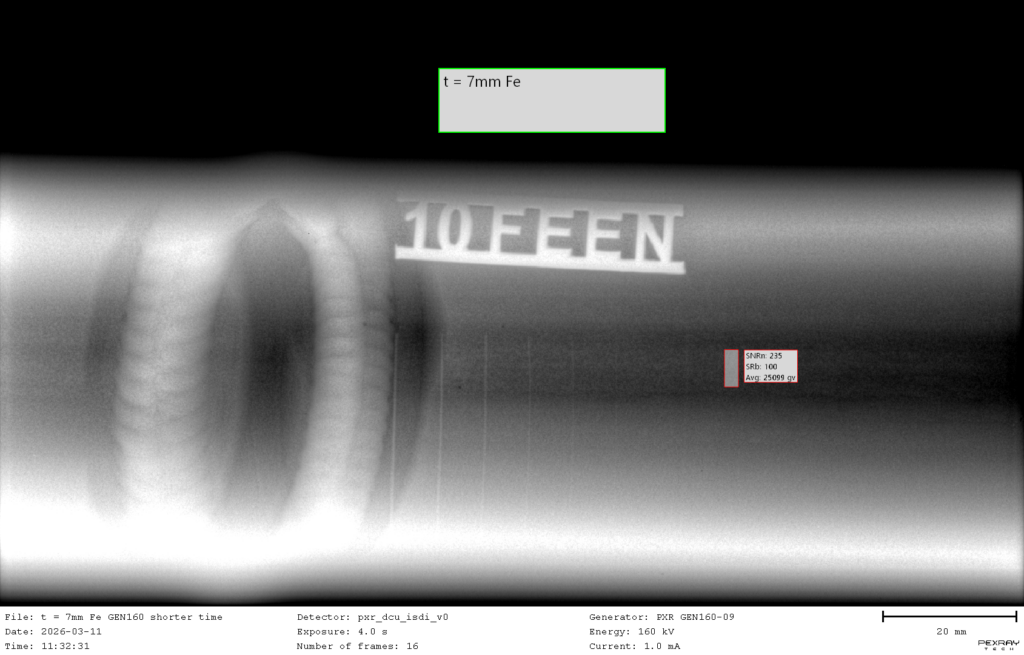
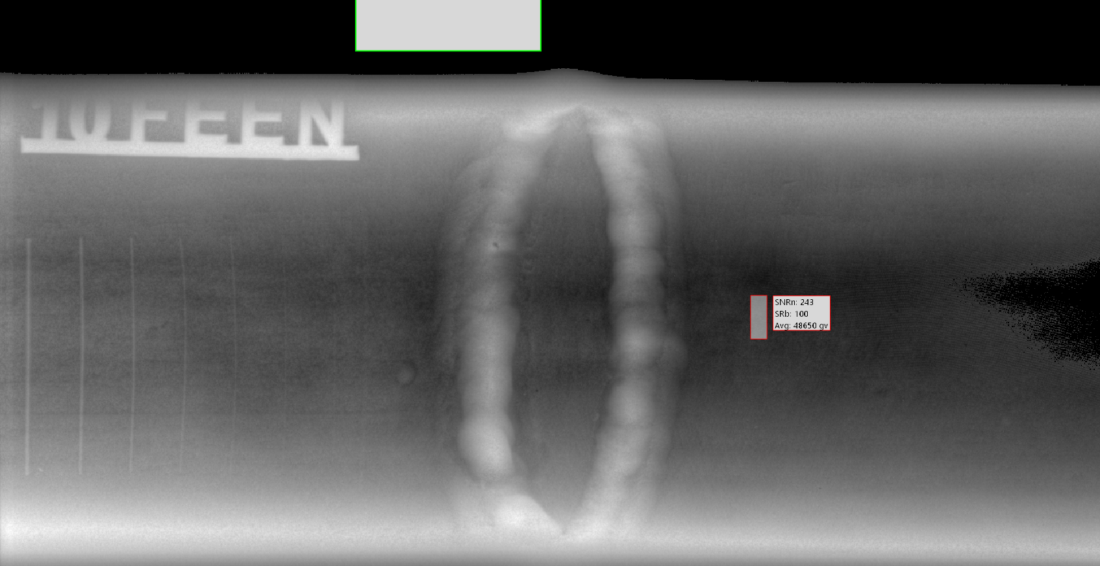
Results can be seen in table below. Resulting X-rays are in the end of the text.

Given thicknesses are for the base material.
We can see from the results that up until ~6.5mm of nominal and 13mm of total penetrated thickness, the performance is really good the operation is fast. For thicknessers above this, the penetration power is more limited and required time is longer. However inspections are still possible, even at very high thicknesses of t = ~+8mm.
It is to be noted that similar total exposure times could be achieved with PXR Alpha 25GF panel.
This test demonstrates the performance of the GEN160-09 battery generator, but also the importance of well-balanced system. In a well-balanced system the generator power, focal spot size and short SDD are matched with high-sensitivity DR panel. In combination like this work is efficient and radiation doses low. In comparison to a old-school system with large focal spot, long SDD combined with high kV & mA output and not-so-sensitive film. These setups lead to maximal doses without any significant benefit on exposure times.
Also, as a final reflection on the matter, we can compare the results of the earlier test with DWSI (double wall, single image) method to this DWDI (double wall, double image) method. As DWSI allows much shorter SDD (source-to-detector) distances, it is possible to penetrate more steel at same power output. Also the geometry is more pleasant for the imaging, as the pipes with sub 100mm diameter have much stronger curvature than the pipes in range of 150 to 200mm in diameter.